“Because Mr. Vance was very clear about this.”
The attorney glanced toward the front of the church, where Mr. Vance’s children were still speaking quietly with relatives.
“He specifically instructed me to give the envelope to you here, immediately following the service. He also instructed me not to discuss its contents with anyone else until you and Noah had decided whether to follow his instructions.”
Noah looked down at the envelope again.
There was no return address.
No name.
Only his first name written across the front in neat, old-fashioned handwriting.
NOAH
My son swallowed.
“He wrote that himself?”
“Yes.”
“When?”
“About three months ago.”
Three months.
That meant Mr. Vance had been planning this while he was still alive.
I felt a strange chill move through me.
Noah carefully turned the envelope over.
There was a small strip of red sealing wax on the back.
Not an ordinary sticker.
An actual wax seal.
Pressed into it was a symbol I didn’t recognize.
A circle surrounding what looked like the letter V.
Noah ran his thumb over it.
“Mom…”
“I see it.”
The attorney cleared his throat.
“There is one more thing.”
Noah looked up.
“Mr. Vance wanted you to know that the money, property, or possessions involved in his instructions are not the important part.”
I frowned.
“Then what is?”
The attorney paused.
“According to Mr. Vance, you’ll understand when you see what he left behind.”
That answer only made things more confusing.I asked, “What did he leave behind?”
The attorney looked directly at Noah.
“That’s for him to discover.”
Then, without another word, he stepped away.
Noah watched him disappear into the crowd.
For several seconds neither of us spoke.
Finally, Noah whispered, “I don’t want anything from him.”
“I know.”
“I never did.”
“I know that too.”
He looked down at the envelope.
“Should I open it?”
I nodded.
“Let’s find somewhere quiet.”
We walked outside.
The afternoon air was cooler than it had been when we arrived. People were gathering in small groups around the church parking lot, speaking softly about Mr. Vance and sharing memories.
Noah and I walked past them.
Neither of us said anything until we reached our car.
Once inside, Noah placed the envelope on his lap.
He stared at it for almost a minute.
Then he broke the seal.
Inside was a single sheet of paper.
Noah unfolded it.
The handwriting was unmistakable.
Mr. Vance’s.
The first line made Noah stop breathing for a moment.
Dear Noah,
He read silently.
Then his eyes widened.
“What?”
I leaned closer.
“What does it say?”
Noah handed me the paper.
I read the next sentence.
If you are reading this, then I have already gone where I cannot answer your questions myself.
My throat tightened.
The letter continued.
Before anything else, I want you to understand something. I never considered what you did for me charity. I considered it a gift. One that I did not deserve, but one I will never forget.
Noah looked away.
I continued reading.
For four years, you came to my house every Saturday. You never asked for money. You never complained. You never once asked why an old man who could barely speak needed a young boy to keep showing up.
My eyes blurred.
Noah quietly wiped his face.
I kept reading.
Then came the sentence that changed everything.
But there is something you never knew about those Saturdays.
I stopped.
Noah looked at me.
“Keep going.”
I did.
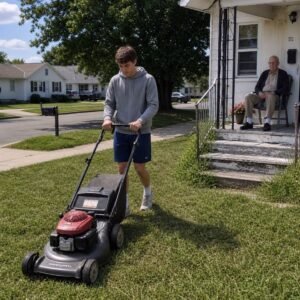
I wasn’t sitting on that porch because I enjoyed watching you mow the lawn.
My heart began beating faster.
I was waiting for you.
Noah stared at the page.
“What does that mean?”
“I don’t know.”
I read the next paragraph.
The first day you crossed the street, I had already decided that I would never ask another person for help. I had spent years believing that needing someone made a person weak. Your arrival proved me wrong.
Noah lowered his head.
For a moment, the car was completely silent.
Then I noticed something else.
There was a second page.
Noah pulled it from the envelope.
At the top were four words.
THE FIRST INSTRUCTION
I looked at him.
“First instruction?”
He nodded slowly.
We continued reading.
Tomorrow morning, at exactly 9:00 a.m., go to my house.
Noah’s eyebrows lifted.
Do not enter through the front door.
We looked at each other.
I felt an uneasy sensation in my chest.
The next line was even stranger.
Take the old blue key hidden beneath the third stone beside the porch.
Noah immediately looked toward the church.
“Mom…”
“I know.”
“That key exists?”
“I have no idea.”
He looked back at the letter.
There was more.
Once inside, go to the room at the end of the hallway. There is a wooden cabinet with three drawers. Open only the bottom drawer.
Then:
Inside you will find something that belonged to my wife.
Noah’s expression changed.
Mr. Vance had almost never spoken about his wife.
I had known she had died years earlier, but I knew little else.
Noah kept reading.
Do not give it to my children.
We both froze.
I looked at him.
“What?”
He reread the sentence.
Slowly.
Then he turned the page.
The next paragraph made my blood run cold.
They will ask you what I left you. Do not tell them. Not yet.
Noah whispered, “Why?”
The letter answered that question—or seemed to.
Because what you find will make you question everything you think you know about me.
There was one final sentence at the bottom.
And Noah, when you discover what is inside that drawer, you will finally understand why I watched you from that porch every Saturday for four years.
The letter ended there.
No signature.
No explanation.
Nothing else.
Noah sat completely still.
I folded the pages carefully.
“Maybe we shouldn’t do this.”
He looked at me.
“Why?”
“Because whatever this is, Mr. Vance clearly wanted to keep it hidden.”
“He also clearly wanted me to find it.”
I didn’t have an answer.
Noah looked through the windshield toward the road leading home.
Then he said something that surprised me.
“I think he was scared.”
“Scared of what?”
“I don’t know.”
He looked down at the letter again.
“But I think he wanted someone to know the truth.”
That night, neither of us slept well.
At 8:15 the next morning, Noah was already dressed.
He stood in the kitchen drinking coffee he didn’t even like.
“You’re sixteen,” I said. “You shouldn’t be drinking that.”
He shrugged.
“You’re nervous too.”
“I am not.”
He gave me a look.
“Mom.”
“Fine. I’m nervous.”
At 8:45, we crossed the street.
Mr. Vance’s house looked exactly the way it always had.
The same faded curtains.
The same cracked flowerpot near the steps.
The same porch chair where he had spent countless Saturdays watching Noah work.
Except now the chair was empty.
For some reason, that hurt more than I expected.
Noah walked toward the porch.
He counted the stones.
“One.”
Then another.
“Two.”
He reached the third.
He crouched down.
For several seconds he simply stared.
Then he lifted it.
Beneath the stone was a small blue key.
Noah slowly picked it up.
Neither of us spoke.
He inserted the key into the side door.
The lock clicked.
The door opened.
A cold draft moved through the hallway.
The house smelled like old wood, dust, and something faintly familiar.
Noah stepped inside.
I followed.
The hallway seemed darker than I remembered.
We walked toward the room at the end.
There it was.
The wooden cabinet.
Three drawers.
Noah reached for the bottom one.
Before he opened it, he stopped.
“Mom?”
“Yes?”
“What if I don’t like what we find?”
I took his hand.
“Then we’ll deal with it together.”
He nodded.
Then he pulled the drawer open.
Inside was a small wooden box wrapped in a faded blue cloth.
On top of the box was a photograph.
Noah picked it up.
His face went completely pale.
“Mom…”
I took the photograph from him.
It showed Mr. Vance many years earlier.
Standing beside his wife.
But they weren’t alone.
There was a little boy standing between them.
A boy who looked strangely familiar.
I stared at the photograph.
Then at Noah.
Then back at the photograph.
On the back, written in Mr. Vance’s handwriting, were six words:
I NEVER TOLD YOU WHO HE WAS.
Noah’s hands began to shake.
And before either of us could say another word, we heard the sound of the front door opening.
Someone had just entered the house.
The Envelope — Part 3: The Truth
Part 3: The Truth
The sound of the front door closing echoed through the house.
Noah froze.
I instinctively pulled him closer.
For a few seconds, neither of us moved.
Then we heard footsteps.
Slow.
Measured.
Coming down the hallway.
Noah whispered, “Who is that?”
“I don’t know.”
The footsteps stopped.
A man’s voice came from the other room.
“Are you Noah?”
Noah looked at me.
I nodded cautiously.
We stepped out of the room.
The man standing in the hallway was the same attorney from the funeral.
He looked at the photograph in Noah’s hand.
Then he sighed.
“I was hoping you’d find that before they did.”
“Who?” I asked.
He didn’t answer immediately.
Instead, he looked at Noah.
“Your mother deserves to know the truth too.”
Noah held up the photograph.
“Who is this boy?”
The attorney stared at the picture for a long moment.
Then he said quietly:
“That is Mr. Vance’s son.”
Noah frowned.
“His son?”
“Yes.”
“But his children were at the funeral.”
“They were.”
“Then who is this?”
The attorney’s expression became painfully serious.
“His first son.”
The room went silent.
I looked again at the photograph.
The little boy couldn’t have been more than six or seven years old.
There was something about his face.
Something familiar.
But I couldn’t understand why.
The attorney walked toward us.
“Mr. Vance had three children,” he explained. “His first son was born many years before the other two.”
“What happened to him?” I asked.
The attorney looked at Noah.
“He disappeared.”
Noah’s face changed.
“Disappeared?”
“When he was seventeen.”
“Did he die?”
“We don’t know.”
I felt a chill.
The attorney continued.
“Mr. Vance spent the rest of his life trying to find him.”
Noah looked at the photograph again.
“But why give this to me?”
The attorney didn’t answer.
Instead, he reached into his coat and removed another envelope.
“This was the second instruction.”
Noah took it.
His hands were trembling.
He opened it.
Inside was a single sheet.
Noah,
If you found the photograph, then you now know about my first son. His name was Daniel.
Daniel disappeared because of me.
I spent decades telling myself that he had abandoned the family. That was easier than admitting the truth.
The truth is that I drove him away.
I was angry, proud, and convinced that a father should never apologize to his son.
I was wrong.
By the time I understood that, Daniel was gone.
I searched for him for thirty-seven years.
I never found him.
But three years ago, someone contacted me.
Noah stopped reading.
He looked at the attorney.
“Who?”
The attorney said nothing.
Noah continued.
That person was Daniel.
I covered my mouth.
Noah’s eyes widened.
“He found him?”
The attorney nodded.
“He did.”
“Then where is he?”
The attorney’s eyes dropped.
“He’s alive.”
Noah stared at him.
“Where?”
The attorney took a slow breath.
“He lives in another state. He has a family of his own. And until recently, he wanted nothing to do with his father.”
Noah looked confused.
“Then why didn’t Mr. Vance tell him he was dying?”
“He did.”
“And?”
“He refused to come.”
Noah looked down.
The attorney continued.
“But Mr. Vance understood. He didn’t blame him.”
He paused.
“That’s when he started thinking about you.”
I felt my eyes fill with tears.
“Why Noah?”
The attorney gave a faint smile.
“Because every Saturday, your son reminded him of the person he had failed to be.”
Noah looked away.
The attorney continued.
“Mr. Vance told me that you never asked for anything. You simply showed up.”
He looked directly at Noah.
“He said that was the first time in decades he believed someone could do something kind without expecting something in return.”
Noah swallowed hard.
“What does Daniel have to do with me?”
The attorney reached into his briefcase.
This time, he removed a small envelope.
On the front was a name.
Daniel Vance.
He handed it to Noah.
“Your grandfather wanted you to deliver this.”
Noah stared at the envelope.
“Grandfather?”
The attorney nodded.
“Mr. Vance was your grandfather.”
The room seemed to tilt.
I couldn’t speak.
Noah couldn’t either.
Then everything began falling into place.
The reason Mr. Vance had watched him.
The strange familiarity I had sometimes noticed between them.
The way Mr. Vance always seemed to become emotional when Noah left after mowing the lawn.
The reason he had never asked Noah for money.
He hadn’t been watching a neighbor’s boy.
He had been watching his grandson.
I whispered, “Why didn’t he tell us?”
The attorney answered gently.
“Because he was afraid.”
“Of what?”
“That if he told you the truth, you’d start helping him because you felt obligated.”
Noah’s eyes filled with tears.
“He thought I’d stop coming?”
“He thought you might feel you had to.”
Noah looked toward the empty porch.
“He didn’t understand.”
“I think,” the attorney said, “that he eventually did.”
He handed Noah one final letter.
“This one is from your grandfather.”
Noah opened it.
His eyes moved slowly across the page.
Then he began to cry.
I put my arm around him.
“What does it say?”
Noah couldn’t speak.
He handed it to me.
I read:
Dear Noah,
If you’ve reached this part, then you know who I am.
I’m sorry you had to learn this after I was gone.
I wanted to tell you a hundred times. Every Saturday, I came close.
But then I’d look at you pushing that mower across my yard, and I realized you weren’t doing it because I was your grandfather.
You were doing it because you saw an old man who needed help.
That was more precious to me than knowing you carried my blood.
You gave me four years I didn’t deserve.
You gave me something even more important than forgiveness.
You gave me hope.
I want you to take the money I’ve left you, but not because I want to repay you for mowing my lawn.
A kindness cannot be repaid with money.
Instead, I want you to use it to build the life you and your mother deserve.
And there is one last thing.
Find Daniel.
Not because he owes me forgiveness.
Because he deserves to know that his father spent his final years regretting what happened.
Tell him I loved him.
Tell him I was too proud to say it when it mattered.
And tell him that my greatest regret was not losing my son.
It was losing the courage to ask him to come home.
Love,
Grandpa
Noah couldn’t hold himself together anymore.
He sat on the floor beside the cabinet and cried.
I sat beside him.
For years, I had watched my son help an old man across the street.
I had thought I was watching an act of kindness.
I never imagined I was watching a grandfather spend his final years quietly getting to know the grandson he had never been brave enough to claim.
Several weeks later, Noah and I drove to meet Daniel.
We almost turned around twice.
But we didn’t.
When the door opened, a man stood there who looked remarkably like the boy in the photograph.
He stared at Noah.
Then at me.
His eyes immediately filled with tears.
“You’re Noah,” he whispered.
Noah nodded.
“I have something for you.”
Daniel looked at the envelope in Noah’s hand.
He didn’t open it right away.
Instead, he asked the only question that seemed to matter.
“Did he suffer?”
Noah shook his head.
“No.”
Then, after a pause, he added:
“He talked about you.”
Daniel closed his eyes.
“What did he say?”
Noah smiled through his tears.
“He said he loved you.”
Daniel began to cry.
And for the first time, the family that had been separated by decades of anger, pride, and silence finally stood together.
Not perfectly.
Not magically healed.
But together.
Before we left, Daniel asked Noah one final question.
“Why did you keep mowing his lawn?”
Noah looked toward me.
Then he smiled.
“Because he needed someone.”
Daniel nodded.
And I realized that was the real inheritance Mr. Vance had left his grandson.
Not the money.
Not the house.
Not the photograph.
It was the lesson.
Sometimes the most valuable thing we leave behind isn’t what we own.
It’s the kindness someone remembers long after we’re gone.
And every Saturday after that, Noah still mowed the lawn.
Only now, there was one difference.
He no longer crossed the street to do it for an old man sitting alone on a porch.
He did it because he had learned something his grandfather had spent a lifetime trying to understand:
Love doesn’t always arrive with a grand confession.
Sometimes it arrives quietly.
Sometimes it pushes an old lawn mower across the street every Saturday for four years.
And sometimes, if we’re lucky, we realize what it meant before it’s too late.